
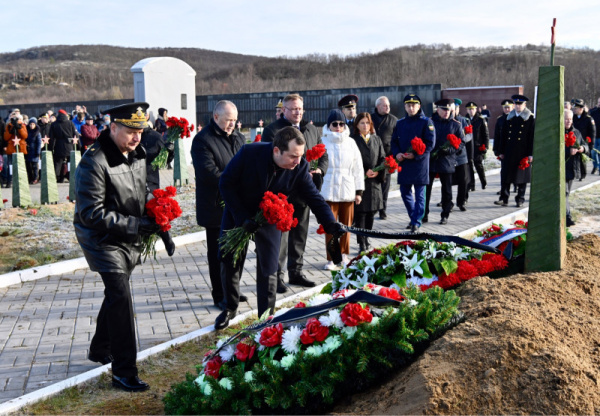
7 октября на территории мемориального комплекса Долина Славы состоялась торжественная церемония захоронения останков советских солдатов, которые защищали Заполярье во время Великой Отечественной войны.
В мероприятии приняли участие представители командования Северного флота, администрации Мурманской области, силовых структур и местной власти, а также военнослужащие подводных сил и армейского корпуса Северного флота, поисковые отряды и члены Юнармии.
Останки 36 красноармейцев были торжественно погребены с воинскими почестями. В честь павших героев был произведен троекратный залп, а также возложены венки и цветы. Воины-североморцы провели торжественный марш, почтя память погибших солдат.
В текущем году поисковые отряды обнаружили останки 58 защитников Мурманской области. Ранее, 14 сентября, на воинском мемориальном кладбище Алакуртти были захоронены останки 22 бойцов.
Эта церемония перезахоронения останков защитников Советского Заполярья, найденных в течение поискового сезона традиционно проводится в Мурманской области в октябре. Она входит в комплекс мероприятий, посвященных годовщине Петсамо-Киркенесской наступательной операции.
Фото: пресс-служба Северного флота
Комментарии
National anthems of some countries which victims came from.
A new book makes the case for a "reunification investment fund" for Kim Jong Un
Gianluca Spezza April 28, 2017
SHARE
North Korean State Media

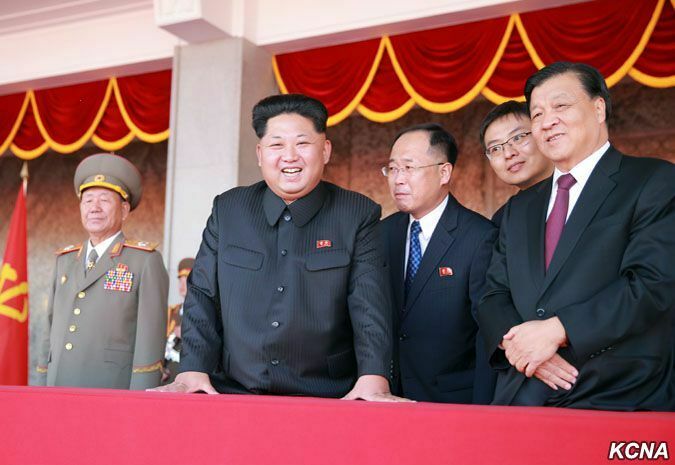
Could the North Korean problem come to an end through a cash settlement? I Photo: NK News
Iverson submits that nothing is gained by Kim’s vilification or punishment, while promising safety and security to Kim and his family may prevent bloodshed. However, if Kim does not acquiesce, elites—many promised $20-30 million—may take matters into their own hands.
Here is where Iverson envisions a silent coup d’état that may be sponsored by well-compensated political and military elites, who would acquiesce to the transfer of power to South Korea.
Most of the book will raise more than a few eyebrows, but, Iverson argues, it’s a case of trying what has never been tried before: financial incentives instead of the current mix of ineffective policies. So, how would the plan work?

Iverson argues North Korea’s elite are financially motivated above all else I Photo: NK News


anonymous, 17.10.2023 в 22:53 div class="detailsCont wow fadeInUp">

Полная версия
Мы ВКонтакте
-
Сегодня в эфире
-
Новости
-
Публикации
-
О нас
-
Реклама
-
Программа
-
Вход
-
Регистрация

Imagine if MCU is real and we deport every Hamasis terrorists and Myanmar fraud den operators to a battleworld not unlike Secret Wars to let them fight each other to end, the world would be much better.
Proposed settlement solutions against Russia
● Financial compensation to the families of MH17 plane crash victims, and extradition of the suspects to the Netherlands. Initial amount should be one million US dollars per wage-earning victim and half a million US dollars per non-wage-earner. This may come in form of foreign exchange reserves and other frozen assets, and profits gained from the sale of natural resources. Additionally, a space mission to the International Space Station should be allocated to Malaysia, as a courtesy of remorse and as happened in 2007, with Russia bearing the full cost of the flight.
● Consenting of an all-Ukrainian referendum on the status of Crimea, DPR and LPR, which entails a swift return to Ukraine or becoming temporary UN-administered territories. Many years later separate referendums in these territories would be held on whether to return to Ukraine, becoming part of Russia or gain independence. The prerequisite being the withdrawal of Russian forces to positions before February 24, 2022. The referenda and the possible establishment of United Nations interim administration in ORDLO areas within Luhansk and Donetsk oblasts contains the prerequisite of Russian withdrawal to positions before February 24, 2022.
● Possible establishment of demilitarized zone at Ukrainian-Russian border, manned by UN troops. Termination of mission occurs upon successful rehabilation and denazification of Russia.
● Consent to the possible creation of a "neutral security belt" between NATO and itself; member countries may include Ukraine, Georgia, Moldova, Armenia, Azerbaijan, Belarus, and Bosnia.
● Monetary reparations by Russia to Ukraine for its reconstruction, totaling at least $100 billion. Again, this may come in form of profits gained from the sale of natural resources. Cancellation of education debts of exemplary students in Ukraine may be possible from this fund.
● Upon the conclusion of status disputes in Crimea, DPR and LPR, an implementation of the demarcation of the delineated Russia–Ukraine border, in consultation with Ukraine.
● Temporary replacement of Russia's United Nations Security Council seat by Ukraine until the former's rehabiliation from fascism. This will be based on a technicality that other former Soviet republics like Ukraine besides Russia can claim succession to the Soviet Union and to get its permanent security council seat.
● Transfer of Sarych and the Antarctic Molodyozhnaya Station to Ukraine.
● Restoration of a pre-1993 parliamentary governance structure.
● Unconditional release by Russia of all Ukrainian prisoner of wars and other individuals who were forcefully relocated due to the war.
● Reduction of nuclear weapons stockpile to 1/3th of present level. In return, other Nuclear Non-Proliferation Treaty parties with over 2,000 warheads should conduct similar measures as well. A token 100 warheads may be preserved for the extraordinary case of asteroid impact avoidance.
● Demilitarisation of Kaliningrad.
● Seizure of patents, copyrights and trademarks from organizations within Russia such as companies known for active participation in the crime of aggression itself, and its associated war crimes. The scale of this seizure should be determined at international forums such as the United Nations.
● Removal of restrictions of workers in intellectual fields such as scientists from exercising their right to a free movement within or beyond Russia; their destinations subjected to UN sanctions' framework.
● Cessation of further obstruction to a hypothetical renewed Iranian nuclear deal, and the transfer of Antarctic Progress Station to Ukraine.
● Allocation of at least one million USD as a seed for Shepherd Iverson's Reunification Investment Fund, and another million to South Korea for the resolution of the border dispute regarding former Noktundo island.
● Cessation of support of the illegitimate Myanmar junta government and the facilitation of the National Unity Government of Myanmar for the restoration of power.
● Final ratification of a final peace treaty between Russia and Japan based on "Soviet–Japanese Joint Declaration of 1956".
● Statutory prohibition against propagation or glorification of extremist ideologies such as Nazism, Fascism, and Leninist-Stalinist Communism.
● Release of political prisoners whose imprisonments are objectively determined to be the result of an abuse of judicial procedures.
● Trial and prosecution by Russian judiciary or the International Criminal Court of persons responsible for crimes of aggression, crimes against humanity, genocide, and violation of customs of war. This includes perpetrators of Bucha Massacre.
● Resumption of participation in Treaty on Open Skies.
● Redirection of some assets in Russia military industrial complexes to more peaceful purposes such as space exploration.
● Creation of an all-comprehensive archive center akin to an Internet Archive's cousin, for the initial purpose of storage of materials related to the war in line with the spirit of "Never Again".
● Cessation of "frozen conflicts" in Moldova and Georgia, and proactive assistance for the cessation of such conflicts in Nagorno-Karabakh.
● Consent to the enlargement of UN Security Council to include Brazil, South Africa and India, and the increase of the minimum number for a veto to two or more.
● Consent to the naming of a newly discovered element as "Ukrainium" in the future.
● Consent to the detachment of Poisk module from the International Space Station during end-of-life and subsequent boosting to heliocentric orbit where it will remain for eternity. Within the detached module, artifacts such as 5D Optical Memory Crystal discs, cremation ashes, locks of hair, artworks and scale model of ISS can be filled inside. The source of the cremation ashes should be primarily from the victims of Mariupol siege, with the full consent of their families.
● Seed money from Russia for the development of antiviral treatment as double-stranded RNA activated caspase oligomerizer and BC 007 for the alleviation its already worse COVID-19 situation, and the eventual construction of an all-comprehensive extraterrestrial knowledge ark, with the ideal location of the middle zone of the Asteroid Belt and beyond, considering the severe risk to humanity posed by climate change.
● Diversion of acceptable amount of reparation funds to assist in the creation of IBSES: International Bank for Space Exploration and Sciences.
Could we pay the North Korean elite to give up power and nukes?
This is a book review of Shepherd Iverson’s Stop North Korea!: A Radical New Approach to Solving the North Korea Standoff. 2017. Tuttle Publishing.
From Kim Il Sung’s birthday on April 15th to the foundation of the country on the 9th of September, year in-year out, North Korea shows a surge in bolder proclamations, military parades, and sometimes, new nuclear tests.
This year, however, under the hardline Trump administration, the ‘propaganda season’ in North Korea could turn out to be more tense than usual. The recent U.S. missile strike on Syria and the moving of U.S. aircraft carriers towards the peninsula as part of the annual joint military exercises between the U.S. and South Korea have already pushed the atmosphere on the peninsula to its worst point in months.
The intractable problem, for many analysts, remains North Korea’s uncertain nuclear capability, and the ‘hostage condition’ – this one quite certain – of Seoul to the North Korean artillery north of the DMZ.
Each and every proposal for reunification and denuclearization of the peninsula comes to a halt with this chicken-and-egg issue: the international community believes reunification cannot happen with nuclear weapons on one side of the peninsula, but the North Korean regime is adamant in keeping the nuclear deterrent for its own survival until reunification is achieved.
There is consensus on the fact that North Korean leadership has historically pursued one objective above all else: survival in power. With a dynastic succession system now at its third generation, and the immense human cost of any military option, the status quo has been adopted by all parts as lowest common denominator. However, if you think denuclearization can only be achieved through regime change, but would prefer it done peacefully, professor Shepherd Iverson, a former professor at Inha University in Incheon, South Korea, has an alternative plan based on incentives.
OTHER INCENTIVES?
What if we could remove the leadership obstacle to unification with a non-military option? This thought has inspired a new book on North Korea which proposes an alternative, bold approach to the conundrum of denuclearization vs reunification.
Iverson argues that instead of prolonging confrontation, it is possible “to buy out North Korea,” in order to reset the clocks and move past the current impasse.
In his work, Iverson envisions a diversified investment plan for the three major segments that compose North Korean society: the elites, the armed forces and security apparatuses, and the remaining millions of regular North Koreans.
This reunification investment fund, as Iverson has named it, is structured to achieve a peaceful transfer of power from the upper political elites and the North Korean military towards South Korea, while the Kim Family would be given the choice to leave – retaining part of their fortune – and continue the rest of their lives elsewhere, away from the public eye.
More than 85% of this money would go directly to impoverished North Koreans and it is likely another trillion dollars of post-unification development investment will also come pouring in over the next few years.
Iverson argues that in order to free the way for denuclearization and reunification, the Kim family and the ruling elite must be removed from the equation, respectively with the promise of immunity for the former and financial incentives for the latter.
This removal, Iverson emphasizes, is conceived to be of a soft nature. There is no hinting to nor a call for any regime change as it is usually advocated for by some human rights groups or – in recent weeks – by the U.S. government towards Syria.
A NEW NORTH KOREA
One of the assumptions behind this buyout proposal is that North Korea is politically ripe for change, because its leadership is not what it used to be, and because the bottom-up, unofficial marketization of the economy is fostering a new ruling class, semi-autonomous from the Kim family and itching for economic opportunities.
The country is simply being held back by a lack of incentives, Iverson argues. Neither the elites nor the military, let alone ordinary citizens, can envision a future beyond the current regime, and this is what keeps the status quo going.
Theories about societal change find confirmation in the testimony of Thae Yong Ho, former deputy DPRK ambassador to the UK, last in a line of defectors turned analysts. He has said described the fragmentation of a once monolithic power structure into a number of family-led factions that constitute the new elites in Pyongyang, and the fact that these could, one day, turn against Kim Jong Un, who does not seem to hold the same degree of power of his father and grandfather.
In similar fashion, a poll of analysts and academics conducted by NK News at the end of 2016, resulted in one of three likely scenarios being the DPRK leadership mired in political and/or economic crisis, and willing to make nuclear concessions.
According to Iverson, the time has come to offer Kim Jong Un a safe exit from international prosecution, before the social situation devolves into a state of general chaos and insurrection. He would personally receive no money, but may be granted immunity from criminal prosecution, and be allowed to keep a portion of his fortune.
THE NITTY GRITTY DETAILS
The reunification investment fund runs at about USD170 billion, an amount similar to that paid for the recent Iranian deal made by the Obama administration, and rests on premises similar to those used for the Mofaz Fund plan for Palestine and Hamas: offer financial incentives for full demilitarization, allowing the counterpart to retire quietly and ‘save face’.
Iverson proposes that we imagine having a multibillion-dollar capital fund at our disposal, and think of North Korea as an underperforming corporation run by an incompetent board of directors — the Kim family and a small number of ultra-elites — who will not relinquish control. Iverson believes it is logical to offer shareholders, political and military elites, government officials and the general population, a higher price for their shares, to convince them to outvote the ruling elite.
Academically trained as an anthropologist, Iverson adopts a culturally materialist approach, arguing that there are very few things that money cannot buy, and North Korean elites in power are not one of them; there must be some level of financial incentive that will impose “insurmountable domestic pressure on the elites” to avoid a civil war, and acquiesce to South Korean political control.
When broken down, the North Korea buyout differs radically from the Iranian deal. The fund is structured to spread these payments over a period of seven years, which would allow for a smooth transition.
Out of the 175.5 billion estimated, 23.3 billion would go to the top elite families with political and economic power in the country; the top ten power elite families would receive $30 million each, while the top thousand would get more than $5 million.
Another 12 billion would go to the military, perhaps the most important piece of the puzzle, in order to guarantee a non-violent transfer of power; 11,000 upper elites, including all generals, would be offered at least $1 million, whilst more than 50,000 mid-level political elites and military officers would receive between $100,000 and $500,000. Aside from the top ten families, the special groups that reside in the capital would receive another 17.9 billion.
Finally, the general population of North Korea would benefit from 121.8 billion, raising the incomes of 300,000 families in Pyongyang, once reunification starts.
Figure 1 (left) details the Reunification Investment Fund budget.
As far as the numbers go, Iverson argues that there is more than enough money going around between South Korean companies and the government alone to cover the 170 billion budget, that is, without considering any outside investor or foreign government. If these were to be considered, then the fund would be ready in no time.
At the height of the Eurozone crisis in 2014-2015, it was estimated that Apple alone could have bailed out Greece twice, and still retain part of its assets. Recent estimates of giant South Korean conglomerates (Samsung, Hyundai, LG) offer a similar comparison. The point, according to Iverson, is not that any private company should get in the business of acquiring entire countries just because they can, but rather that with the right set of incentives, these companies could contribute to the rebirth of a unified nation, and reap immense economic rewards in return. Iverson speculates that geoeconomic approaches will become more important in the twenty-first century.
WHO PAYS WHO?
Things get more complicated when it comes to understanding where the money would come from, particularly for the part of the fund that, in essence, goes to remunerate the current elite groups of Pyongyang. Iverson’s proposal also raises questions of morality: who would be willing to finance a golden exile for an elite that is allegedly responsible for some of the worst human rights abuses in recent history, and is it acceptable to do so?
The answers to these two questions are intertwined. According to Iverson, if one looks at the chain of command in North Korea, under Kim Jong Un it appears that the people that are in power now are relatively ‘innocent’: they did not build the system they inherited, and simply had no choice but to perpetuate the system because there is no alternative for them and if they were to openly rebel, they would be put to death.
Iverson answers the moral question arguing that it makes little sense to wait out for the circumstances that would allow the international prosecution of Kim Jong Un. This is something that could very well never happen, unless the country was taken by force.
The real question, Iverson asks, is what would the North Korean people gain from the prosecution of one man, or a small elite group? In comparison with a sense of historical justice, achieved 20 years down the road, Iverson proposes to find a way for ordinary North Koreans to have a future and for the next generation to enjoy prosperity in a unified country, rather than endure decades of poverty and decline, waiting for the regime to implode.
The money to buyout elites would have to would have to come from private groups, through a cascade of business and investment opportunities allocated by the South Korean government to private companies, both Korean and international, which would them disburse the money to political and military elites in the DPRK. Taxpayer money would not be necessary.
Figure 2 (right) explains the flow of investments (courtesy of S. Iverson)
THE STATUS QUO
Aside from explaining why a North Korean buyout is possible and necessary, Iverson also elaborates on the consequences of prolonging the status quo.
On the one hand, North Korea, according to Iverson is a humanitarian catastrophe waiting to happen; the current pace of UN aid programs are barely enough the keep the country afloat, and much more would be needed if the system were to halt tomorrow. Regime collapse, according to Iverson, would also bring a new unjust partition of the peninsula.
With no reunification agreement in place, Iverson speculates that Beijing could claim for itself a third of what is now the North Korean territory, drawing a border line from Anju on the west to Hamhung on the east. China could do this undisturbed, Iverson adds, because it has the strongest land forces at the moment, and the U.S. would not want to get involved in another 1951 scenario.
On the other hand, Iverson describes the DPRK as a proxy for Chinese strategy against U.S. interests worldwide, together with Iran and Pakistan. Iverson rejects the hypothesis, common among scholars, that China can no longer stand the periodical saber-rattling episodes of North Korea and would much like to see it gone, as long as it can ensure that no U.S. troops would walk along the Yalu river.
Instead, he looks at trade figures between China and the DPRK to argue that, substantially, Beijing is paying for the North Korean missile program.
Since the first nuclear test in 2006, trade between the two countries increased fourfold, and this signals to Iverson that North Korea is being supported as a ‘hostile surrogate’, ready to carry out destabilizing actions in the region that strengthen the position of China and create more problems for the U.S.
The idea of a North Korean buyout is not as outlandish as it may sound at first, especially to non-specialists. If one decides to crunch the numbers, what Iverson proposes sounds much more feasible than many other reunification proposals published during the 2000s.
It is certainly true that almost everything, aside from military action, has been tried to change the status quo on the peninsula and nothing has even come close to succeeding.
Iverson contends that in order for this proposal to reach North Korea in the most authoritative way, a figure like Donald Trump may be decisive, as the current administration has made it clear that it does not fear a bold approach to foreign policy issues. A problem that awaits down the line and has not been thoroughly considered lies, however, with the Korean people themselves.
With the wartime generation dying out both in Seoul and Pyongyang, and the younger South Koreans showing little to no interest in assimilating with North Koreans, it may be all too late. South of the DMZ, many think that the divide between the two states has widened so much that even with a political solution, the two societies may now be too far apart and real unification will never be possible.
The upcoming political elections in Seoul could help in clearing up some of these doubts. But whoever wins, if Iverson has his way, denuclearization and reunification would be accomplished through public and private cooperation—and G-20 blessing—in bribing the North Korean power elite.
Edited by Oliver Hotham
We are AnonymousWe are legion
Чтобы оставлять комментарии, необходимо войти или зарегистрироваться
National anthems of some countries which victims came from.
A new book makes the case for a "reunification investment fund" for Kim Jong Un
Gianluca Spezza April 28, 2017

SHARE
North Korean State Media

Could the North Korean problem come to an end through a cash settlement? I Photo: NK News
Iverson submits that nothing is gained by Kim’s vilification or punishment, while promising safety and security to Kim and his family may prevent bloodshed. However, if Kim does not acquiesce, elites—many promised $20-30 million—may take matters into their own hands.
Here is where Iverson envisions a silent coup d’état that may be sponsored by well-compensated political and military elites, who would acquiesce to the transfer of power to South Korea.
Most of the book will raise more than a few eyebrows, but, Iverson argues, it’s a case of trying what has never been tried before: financial incentives instead of the current mix of ineffective policies. So, how would the plan work?

Iverson argues North Korea’s elite are financially motivated above all else I Photo: NK News


19:21

Жители Мурманска и Апатитов смогут бесплатно проверить иммунитет
18:36

Мурманская область стала площадкой для съемок популярного китайского шоу
Imagine if MCU is real and we deport every Hamasis terrorists and Myanmar fraud den operators to a battleworld not unlike Secret Wars to let them fight each other to end, the world would be much better.
Proposed settlement solutions against Russia
● Financial compensation to the families of MH17 plane crash victims, and extradition of the suspects to the Netherlands. Initial amount should be one million US dollars per wage-earning victim and half a million US dollars per non-wage-earner. This may come in form of foreign exchange reserves and other frozen assets, and profits gained from the sale of natural resources. Additionally, a space mission to the International Space Station should be allocated to Malaysia, as a courtesy of remorse and as happened in 2007, with Russia bearing the full cost of the flight.
● Consenting of an all-Ukrainian referendum on the status of Crimea, DPR and LPR, which entails a swift return to Ukraine or becoming temporary UN-administered territories. Many years later separate referendums in these territories would be held on whether to return to Ukraine, becoming part of Russia or gain independence. The prerequisite being the withdrawal of Russian forces to positions before February 24, 2022. The referenda and the possible establishment of United Nations interim administration in ORDLO areas within Luhansk and Donetsk oblasts contains the prerequisite of Russian withdrawal to positions before February 24, 2022.
● Possible establishment of demilitarized zone at Ukrainian-Russian border, manned by UN troops. Termination of mission occurs upon successful rehabilation and denazification of Russia.
● Consent to the possible creation of a "neutral security belt" between NATO and itself; member countries may include Ukraine, Georgia, Moldova, Armenia, Azerbaijan, Belarus, and Bosnia.
● Monetary reparations by Russia to Ukraine for its reconstruction, totaling at least $100 billion. Again, this may come in form of profits gained from the sale of natural resources. Cancellation of education debts of exemplary students in Ukraine may be possible from this fund.
● Upon the conclusion of status disputes in Crimea, DPR and LPR, an implementation of the demarcation of the delineated Russia–Ukraine border, in consultation with Ukraine.
● Temporary replacement of Russia's United Nations Security Council seat by Ukraine until the former's rehabiliation from fascism. This will be based on a technicality that other former Soviet republics like Ukraine besides Russia can claim succession to the Soviet Union and to get its permanent security council seat.
● Transfer of Sarych and the Antarctic Molodyozhnaya Station to Ukraine.
● Restoration of a pre-1993 parliamentary governance structure.
● Unconditional release by Russia of all Ukrainian prisoner of wars and other individuals who were forcefully relocated due to the war.
● Reduction of nuclear weapons stockpile to 1/3th of present level. In return, other Nuclear Non-Proliferation Treaty parties with over 2,000 warheads should conduct similar measures as well. A token 100 warheads may be preserved for the extraordinary case of asteroid impact avoidance.
● Demilitarisation of Kaliningrad.
● Seizure of patents, copyrights and trademarks from organizations within Russia such as companies known for active participation in the crime of aggression itself, and its associated war crimes. The scale of this seizure should be determined at international forums such as the United Nations.
● Removal of restrictions of workers in intellectual fields such as scientists from exercising their right to a free movement within or beyond Russia; their destinations subjected to UN sanctions' framework.
● Cessation of further obstruction to a hypothetical renewed Iranian nuclear deal, and the transfer of Antarctic Progress Station to Ukraine.
● Allocation of at least one million USD as a seed for Shepherd Iverson's Reunification Investment Fund, and another million to South Korea for the resolution of the border dispute regarding former Noktundo island.
● Cessation of support of the illegitimate Myanmar junta government and the facilitation of the National Unity Government of Myanmar for the restoration of power.
● Final ratification of a final peace treaty between Russia and Japan based on "Soviet–Japanese Joint Declaration of 1956".
● Statutory prohibition against propagation or glorification of extremist ideologies such as Nazism, Fascism, and Leninist-Stalinist Communism.
● Release of political prisoners whose imprisonments are objectively determined to be the result of an abuse of judicial procedures.
● Trial and prosecution by Russian judiciary or the International Criminal Court of persons responsible for crimes of aggression, crimes against humanity, genocide, and violation of customs of war. This includes perpetrators of Bucha Massacre.
● Resumption of participation in Treaty on Open Skies.
● Redirection of some assets in Russia military industrial complexes to more peaceful purposes such as space exploration.
● Creation of an all-comprehensive archive center akin to an Internet Archive's cousin, for the initial purpose of storage of materials related to the war in line with the spirit of "Never Again".
● Cessation of "frozen conflicts" in Moldova and Georgia, and proactive assistance for the cessation of such conflicts in Nagorno-Karabakh.
● Consent to the enlargement of UN Security Council to include Brazil, South Africa and India, and the increase of the minimum number for a veto to two or more.
● Consent to the naming of a newly discovered element as "Ukrainium" in the future.
● Consent to the detachment of Poisk module from the International Space Station during end-of-life and subsequent boosting to heliocentric orbit where it will remain for eternity. Within the detached module, artifacts such as 5D Optical Memory Crystal discs, cremation ashes, locks of hair, artworks and scale model of ISS can be filled inside. The source of the cremation ashes should be primarily from the victims of Mariupol siege, with the full consent of their families.
● Seed money from Russia for the development of antiviral treatment as double-stranded RNA activated caspase oligomerizer and BC 007 for the alleviation its already worse COVID-19 situation, and the eventual construction of an all-comprehensive extraterrestrial knowledge ark, with the ideal location of the middle zone of the Asteroid Belt and beyond, considering the severe risk to humanity posed by climate change.
● Diversion of acceptable amount of reparation funds to assist in the creation of IBSES: International Bank for Space Exploration and Sciences.
Could we pay the North Korean elite to give up power and nukes?
This is a book review of Shepherd Iverson’s Stop North Korea!: A Radical New Approach to Solving the North Korea Standoff. 2017. Tuttle Publishing.
From Kim Il Sung’s birthday on April 15th to the foundation of the country on the 9th of September, year in-year out, North Korea shows a surge in bolder proclamations, military parades, and sometimes, new nuclear tests.
This year, however, under the hardline Trump administration, the ‘propaganda season’ in North Korea could turn out to be more tense than usual. The recent U.S. missile strike on Syria and the moving of U.S. aircraft carriers towards the peninsula as part of the annual joint military exercises between the U.S. and South Korea have already pushed the atmosphere on the peninsula to its worst point in months.
The intractable problem, for many analysts, remains North Korea’s uncertain nuclear capability, and the ‘hostage condition’ – this one quite certain – of Seoul to the North Korean artillery north of the DMZ.
Each and every proposal for reunification and denuclearization of the peninsula comes to a halt with this chicken-and-egg issue: the international community believes reunification cannot happen with nuclear weapons on one side of the peninsula, but the North Korean regime is adamant in keeping the nuclear deterrent for its own survival until reunification is achieved.
There is consensus on the fact that North Korean leadership has historically pursued one objective above all else: survival in power. With a dynastic succession system now at its third generation, and the immense human cost of any military option, the status quo has been adopted by all parts as lowest common denominator. However, if you think denuclearization can only be achieved through regime change, but would prefer it done peacefully, professor Shepherd Iverson, a former professor at Inha University in Incheon, South Korea, has an alternative plan based on incentives.
OTHER INCENTIVES?
What if we could remove the leadership obstacle to unification with a non-military option? This thought has inspired a new book on North Korea which proposes an alternative, bold approach to the conundrum of denuclearization vs reunification.
Iverson argues that instead of prolonging confrontation, it is possible “to buy out North Korea,” in order to reset the clocks and move past the current impasse.
In his work, Iverson envisions a diversified investment plan for the three major segments that compose North Korean society: the elites, the armed forces and security apparatuses, and the remaining millions of regular North Koreans.
This reunification investment fund, as Iverson has named it, is structured to achieve a peaceful transfer of power from the upper political elites and the North Korean military towards South Korea, while the Kim Family would be given the choice to leave – retaining part of their fortune – and continue the rest of their lives elsewhere, away from the public eye.
More than 85% of this money would go directly to impoverished North Koreans and it is likely another trillion dollars of post-unification development investment will also come pouring in over the next few years.
Iverson argues that in order to free the way for denuclearization and reunification, the Kim family and the ruling elite must be removed from the equation, respectively with the promise of immunity for the former and financial incentives for the latter.
This removal, Iverson emphasizes, is conceived to be of a soft nature. There is no hinting to nor a call for any regime change as it is usually advocated for by some human rights groups or – in recent weeks – by the U.S. government towards Syria.
A NEW NORTH KOREA
One of the assumptions behind this buyout proposal is that North Korea is politically ripe for change, because its leadership is not what it used to be, and because the bottom-up, unofficial marketization of the economy is fostering a new ruling class, semi-autonomous from the Kim family and itching for economic opportunities.
The country is simply being held back by a lack of incentives, Iverson argues. Neither the elites nor the military, let alone ordinary citizens, can envision a future beyond the current regime, and this is what keeps the status quo going.
Theories about societal change find confirmation in the testimony of Thae Yong Ho, former deputy DPRK ambassador to the UK, last in a line of defectors turned analysts. He has said described the fragmentation of a once monolithic power structure into a number of family-led factions that constitute the new elites in Pyongyang, and the fact that these could, one day, turn against Kim Jong Un, who does not seem to hold the same degree of power of his father and grandfather.
In similar fashion, a poll of analysts and academics conducted by NK News at the end of 2016, resulted in one of three likely scenarios being the DPRK leadership mired in political and/or economic crisis, and willing to make nuclear concessions.
According to Iverson, the time has come to offer Kim Jong Un a safe exit from international prosecution, before the social situation devolves into a state of general chaos and insurrection. He would personally receive no money, but may be granted immunity from criminal prosecution, and be allowed to keep a portion of his fortune.
THE NITTY GRITTY DETAILS
The reunification investment fund runs at about USD170 billion, an amount similar to that paid for the recent Iranian deal made by the Obama administration, and rests on premises similar to those used for the Mofaz Fund plan for Palestine and Hamas: offer financial incentives for full demilitarization, allowing the counterpart to retire quietly and ‘save face’.
Iverson proposes that we imagine having a multibillion-dollar capital fund at our disposal, and think of North Korea as an underperforming corporation run by an incompetent board of directors — the Kim family and a small number of ultra-elites — who will not relinquish control. Iverson believes it is logical to offer shareholders, political and military elites, government officials and the general population, a higher price for their shares, to convince them to outvote the ruling elite.
Academically trained as an anthropologist, Iverson adopts a culturally materialist approach, arguing that there are very few things that money cannot buy, and North Korean elites in power are not one of them; there must be some level of financial incentive that will impose “insurmountable domestic pressure on the elites” to avoid a civil war, and acquiesce to South Korean political control.
When broken down, the North Korea buyout differs radically from the Iranian deal. The fund is structured to spread these payments over a period of seven years, which would allow for a smooth transition.
Out of the 175.5 billion estimated, 23.3 billion would go to the top elite families with political and economic power in the country; the top ten power elite families would receive $30 million each, while the top thousand would get more than $5 million.
Another 12 billion would go to the military, perhaps the most important piece of the puzzle, in order to guarantee a non-violent transfer of power; 11,000 upper elites, including all generals, would be offered at least $1 million, whilst more than 50,000 mid-level political elites and military officers would receive between $100,000 and $500,000. Aside from the top ten families, the special groups that reside in the capital would receive another 17.9 billion.
Finally, the general population of North Korea would benefit from 121.8 billion, raising the incomes of 300,000 families in Pyongyang, once reunification starts.
Figure 1 (left) details the Reunification Investment Fund budget.
As far as the numbers go, Iverson argues that there is more than enough money going around between South Korean companies and the government alone to cover the 170 billion budget, that is, without considering any outside investor or foreign government. If these were to be considered, then the fund would be ready in no time.
At the height of the Eurozone crisis in 2014-2015, it was estimated that Apple alone could have bailed out Greece twice, and still retain part of its assets. Recent estimates of giant South Korean conglomerates (Samsung, Hyundai, LG) offer a similar comparison. The point, according to Iverson, is not that any private company should get in the business of acquiring entire countries just because they can, but rather that with the right set of incentives, these companies could contribute to the rebirth of a unified nation, and reap immense economic rewards in return. Iverson speculates that geoeconomic approaches will become more important in the twenty-first century.
WHO PAYS WHO?
Things get more complicated when it comes to understanding where the money would come from, particularly for the part of the fund that, in essence, goes to remunerate the current elite groups of Pyongyang. Iverson’s proposal also raises questions of morality: who would be willing to finance a golden exile for an elite that is allegedly responsible for some of the worst human rights abuses in recent history, and is it acceptable to do so?
The answers to these two questions are intertwined. According to Iverson, if one looks at the chain of command in North Korea, under Kim Jong Un it appears that the people that are in power now are relatively ‘innocent’: they did not build the system they inherited, and simply had no choice but to perpetuate the system because there is no alternative for them and if they were to openly rebel, they would be put to death.
Iverson answers the moral question arguing that it makes little sense to wait out for the circumstances that would allow the international prosecution of Kim Jong Un. This is something that could very well never happen, unless the country was taken by force.
The real question, Iverson asks, is what would the North Korean people gain from the prosecution of one man, or a small elite group? In comparison with a sense of historical justice, achieved 20 years down the road, Iverson proposes to find a way for ordinary North Koreans to have a future and for the next generation to enjoy prosperity in a unified country, rather than endure decades of poverty and decline, waiting for the regime to implode.
The money to buyout elites would have to would have to come from private groups, through a cascade of business and investment opportunities allocated by the South Korean government to private companies, both Korean and international, which would them disburse the money to political and military elites in the DPRK. Taxpayer money would not be necessary.
Figure 2 (right) explains the flow of investments (courtesy of S. Iverson)
THE STATUS QUO
Aside from explaining why a North Korean buyout is possible and necessary, Iverson also elaborates on the consequences of prolonging the status quo.
On the one hand, North Korea, according to Iverson is a humanitarian catastrophe waiting to happen; the current pace of UN aid programs are barely enough the keep the country afloat, and much more would be needed if the system were to halt tomorrow. Regime collapse, according to Iverson, would also bring a new unjust partition of the peninsula.
With no reunification agreement in place, Iverson speculates that Beijing could claim for itself a third of what is now the North Korean territory, drawing a border line from Anju on the west to Hamhung on the east. China could do this undisturbed, Iverson adds, because it has the strongest land forces at the moment, and the U.S. would not want to get involved in another 1951 scenario.
On the other hand, Iverson describes the DPRK as a proxy for Chinese strategy against U.S. interests worldwide, together with Iran and Pakistan. Iverson rejects the hypothesis, common among scholars, that China can no longer stand the periodical saber-rattling episodes of North Korea and would much like to see it gone, as long as it can ensure that no U.S. troops would walk along the Yalu river.
Instead, he looks at trade figures between China and the DPRK to argue that, substantially, Beijing is paying for the North Korean missile program.
Since the first nuclear test in 2006, trade between the two countries increased fourfold, and this signals to Iverson that North Korea is being supported as a ‘hostile surrogate’, ready to carry out destabilizing actions in the region that strengthen the position of China and create more problems for the U.S.
The idea of a North Korean buyout is not as outlandish as it may sound at first, especially to non-specialists. If one decides to crunch the numbers, what Iverson proposes sounds much more feasible than many other reunification proposals published during the 2000s.
It is certainly true that almost everything, aside from military action, has been tried to change the status quo on the peninsula and nothing has even come close to succeeding.
Iverson contends that in order for this proposal to reach North Korea in the most authoritative way, a figure like Donald Trump may be decisive, as the current administration has made it clear that it does not fear a bold approach to foreign policy issues. A problem that awaits down the line and has not been thoroughly considered lies, however, with the Korean people themselves.
With the wartime generation dying out both in Seoul and Pyongyang, and the younger South Koreans showing little to no interest in assimilating with North Koreans, it may be all too late. South of the DMZ, many think that the divide between the two states has widened so much that even with a political solution, the two societies may now be too far apart and real unification will never be possible.
The upcoming political elections in Seoul could help in clearing up some of these doubts. But whoever wins, if Iverson has his way, denuclearization and reunification would be accomplished through public and private cooperation—and G-20 blessing—in bribing the North Korean power elite.
Edited by Oliver Hotham
We are AnonymousWe are legion
Чтобы оставлять комментарии, необходимо войти или зарегистрироваться
Ваш комментарий
Чтобы оставлять комментарии, необходимо войти или зарегистрироваться
Другие новости дня
Заказать песню
Предложить новость
Плейлист
Вход
Регистрация